
Searching Scotts Bluff County Civil Dockets
When you have a party name or case number, the JUSTICE One-Time Court Case Search is the place to begin. Nebraska runs this as a paid statewide search. It is not a Scotts Bluff-only civil portal. The public entry page shows the terms. Expect $17 per search, up to 30 returned records, three calendar days of access, and roughly a 24-hour lag. Filtering by court, case type, county, year, or case number helps sort out people who share a name. Results can show public case information plus register or image information where offered. They are no substitute for a clerk copy.
For heavier use, the subscriber service offers an annual account. Its criteria reach party name, court type, case type or subtype, county, year, judge, attorney, case number, and judgment date. Search the name exactly as the case recorded it. Watch for alternate spellings too. A matching name alone never proves two records belong to the same person. Weigh the other details before you assume a match.
- Identify whether the civil matter belongs in County Court or District Court.
- Use JUSTICE with the party name or known case number and narrow the court when possible.
- Open the matching public record and read the register from the filing date forward.
- Use the clerk or courthouse terminal when an older, paper-only, restricted, or missing image needs confirmation.
Scotts Bluff County Civil Jurisdiction Line
Jurisdiction decides which court holds a Scotts Bluff County civil docket. Under Nebraska Rule 6-1462, County Court handles civil claims up to $70,000. That ceiling runs from July 1, 2025 through June 30, 2030. Small claims top out at $7,500. Ignore older local statements citing a lower figure, since those thresholds are outdated.
County Court also keeps several other dockets. These include small claims, probate, guardianship and conservatorship, adoption, protection orders, and civil matters within its limit. District Court holds civil and equity cases in district jurisdiction along with domestic-relations files. Do not let a familiar case label decide the court level for you. The caption, filing type, amount, and docket history can all point somewhere unexpected.
| Civil record type | Usual Scotts Bluff starting court | Why the split matters |
|---|---|---|
| Small claims or civil within County Court jurisdiction | County Court | The County Court Clerk Magistrate keeps that register and file. |
| Civil or equity matter outside County Court jurisdiction | District Court | The Clerk of the District Court keeps the district register and judgment records. |
| Domestic relations | District Court | The district civil file may be the primary record path. |
Inside a Scotts Bluff County Civil Docket
The register of actions is the official chronological court record under Rule 6-1523. In a civil case it can list the case ID, caption, subtype, judge, filing dates, summons issue and return data, pleadings, motions, notices, orders, settings, judgment, satisfaction, and the financial record. Note that the trial docket and the individual case file are related records. Neither is just another name for the register.
| Case identification and caption | Identifies the case, parties, type, subtype, and filing date. |
|---|---|
| Service entries | Shows summons issuance, service activity, and return information when part of the record. |
| Filings and motions | Records a complaint or petition, answer, amended pleading, motion, notice, or order. |
| Settings | Shows a hearing, status conference, trial setting, continuance, or reset. |
| Judgment information | Can include judgment, satisfaction or release, and related financial entries. |
Those components come straight from the District Court records-maintenance rule. The rule also explains why a register line reading "motion filed" is not the motion itself. When the wording matters, open an available image or ask the clerk for the document.
Scotts Bluff County Civil Filing Volume
For scale, the FY2025 County Court caseload report lists 2,610 Scotts Bluff civil filings, plus 89 small claims cases, 121 probate cases, 41 guardianship or conservatorship cases, and 24 adoptions. The district report separately counts 136 civil filings and 237 domestic-relations filings for Scotts Bluff. These numbers count filings, not people, homes, or final judgments.
In a busy civil docket, case type, court, and year narrow the field fast. They also help a clerk pull the right record when an online result is thin or a name returns too many matches.
Scotts Bluff County Civil Document Images
A register entry and a document image are different things. JUSTICE shows images where they exist. These include documents filed or uploaded after April 16, 2008 where available. No image is guaranteed for every civil filing. Older paper records, or files outside a court's installation history, may still need a clerk, a courthouse terminal, or a plain copy request.
An entry may name a pleading, order, or judgment you need. Take its title and date and make a focused CC 3:29 request. That gives the Scotts Bluff clerk enough to find the document quickly. A missing online image does not mean the civil record is absent.
Civil Case Types on the Docket
Scotts Bluff County Court civil registers span several categories. They can include ordinary civil matters, small claims, probate, guardianship or conservatorship, adoption, and protection orders. District Court records can include civil, domestic-relations, protection-order, equity, and related district actions. The register structure looks similar across categories. The confidentiality boundaries, though, differ from one category to the next.
A public docket does not put every document or personal detail online. Nebraska public-access rules cover party indexes, public case summaries, registers, available images, calendars, and judgment or order summaries. All of it stays subject to restrictions. Public file inspection under Rule 2-215 still yields to sealing, confidentiality rules, redaction, and paper-record limits.
Scotts Bluff County Judgment Indexes
District Court keeps an alphabetical judgment index for Scotts Bluff County. You may find debtor and creditor names there, plus case IDs and satisfaction notes. Think of it as a finding aid. The index cannot stand in for the judgment itself. Nor does it capture every order entered in a case. The procedural detail lives in the register and the actual judgment document.
Need a copy of a judgment, motion, or other filing? Use form CC 3:29. The form asks which court, the case number, the case name, the document name, its date, your delivery preference, and prepaid costs. Fees run low. Electronic non-certified copies list no charge. Mailed non-certified copies cost $0.25 per page. Emailed certified copies run $1 per request, and mailed certified copies add $1 per seal plus $0.25 per page.
Civil Docket Settings and Hearings
A Scotts Bluff County civil register can carry many kinds of entries. Look for a notice of setting, a hearing, or a status entry. Mediation, a continuance, or an order may appear too. For a current or future court date, the Multi-Court Case Calendar is the tool. It lets you pick County Court or District Court. You can search by date or last name. Remember that a calendar hit is a date tool. It is not the full civil docket.
Scotts Bluff takes part in the statewide calendar system. The calendar itself warns that a blank result does not rule out a court date. It also promises nothing about timeliness. To confirm a date, call County Court at 308-436-6650. For a district matter, call District Court at 308-436-6641. The clerk can tell you which court fits your case but cannot give legal advice.
Scotts Bluff County Civil Appeal Path
A County Court civil or small-claims judgment can spawn a later record. That record may sit in Scotts Bluff County District Court. Nebraska's county-to-district appeal guidance spells out a 30-day appeal window. It also covers the notice, the fee, the transcript, and the bill-of-exceptions requirements. That path explains why a careful civil docket search should cover two files. Check the original County Court case. Check any later District Court file too.
Further appeals go to the Nebraska Court of Appeals. Those appeals are subject to Supreme Court review or bypass rules. The appellate record is a separate court record path. It is not an extension of the local trial-court register. The Nebraska Court of Appeals page shows how that distinct appellate layer works.
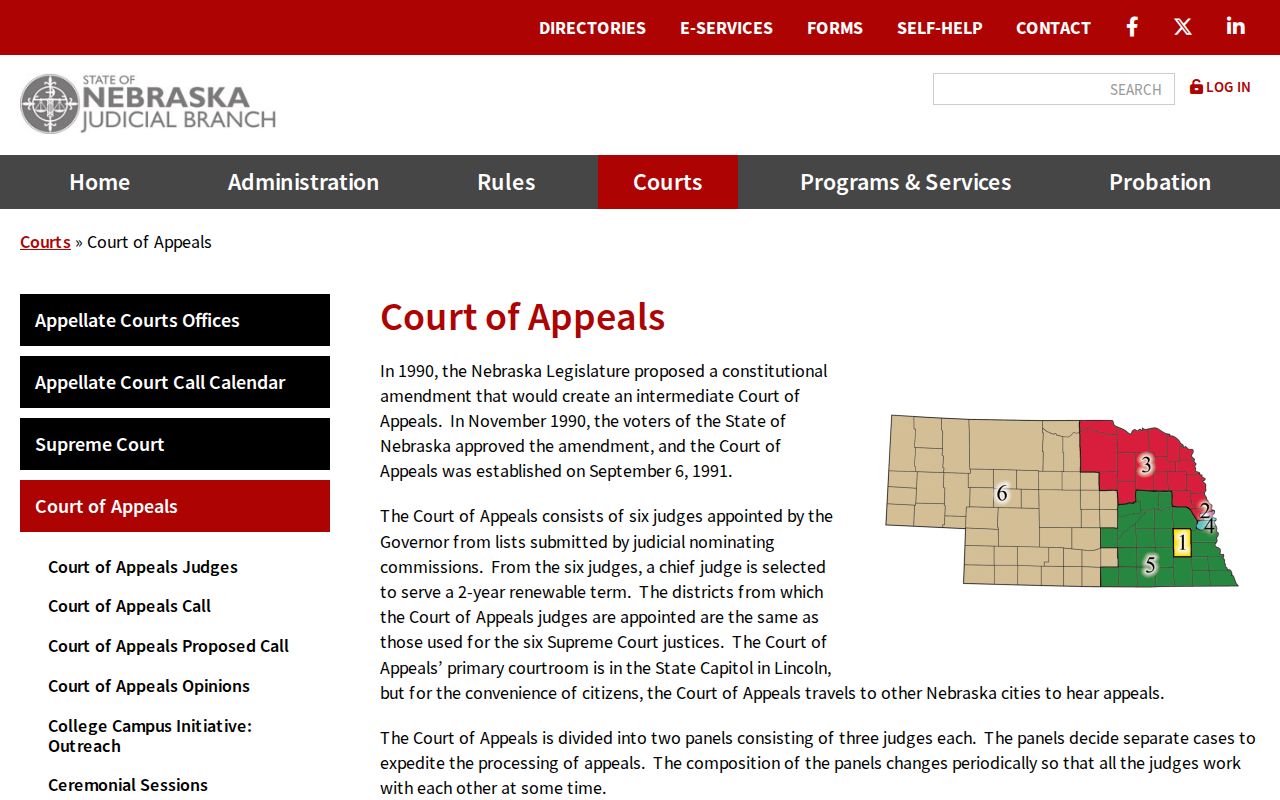
That separation has a practical sting. A case caption can appear in the local docket while its later appeal stays invisible to the same trial-court search.
Civil Docket Access Rules
Public does not mean wide open. Nebraska's public-court-files rule generally lets you inspect public filings at the clerk terminal. The State Law Library offers access as well. Confidential, sealed, and restricted items sit outside ordinary public access, though. A civil case missing from an online result may be paper-only. It could be older than the local JUSTICE installation, restricted, sitting in the other trial court, or simply unavailable through the public result.
Use the correct route. A courthouse terminal can be searched by party name or case number. County Court handles its own civil files; District Court handles its own civil and domestic records. A CC 3:29 request goes to the clerk who holds the file, not to the general county office.
County Court sits at 1725 10th Street, first level, Gering, with a main clerk line of 308-436-6648. District Court is upstairs on the second level, where Darla Simpson's clerk office takes calls at 308-436-6641. When no online image exists, the counter and its terminal still serve you well.
Scotts Bluff County Civil Record Requests
For a routine copy, name the court, case number, case name, document, and date. Then send CC 3:29 to the right County Court or District Court clerk. The local pages publish phone and fax numbers. The county offers no dedicated online upload route for CC 3:29. No turnaround time is guaranteed. Ask the clerk whether mail, fax, email, or in-person delivery works before you send anything.
A formal written request under the Nebraska Public Records Act, section 84-712 takes more care. State the court record you want, your delivery method, and your requested cost estimate. Court policy sends formal requests to the State Court Administrator. This route opens public records; it does not pry open confidential or sealed material.