
Searching Scotts Bluff County Criminal Dockets
Nebraska's paid JUSTICE One-Time Court Case Search is the statewide starting point for a known criminal matter. It covers public court information. It is not a full-text docket database for the county. Search with the defendant's legal name, not a witness name. Narrow the results, and confirm the court level before you trust a match. A one-time search costs $17. It returns up to 30 records and stays open for three calendar days after purchase. Expect an approximate 24-hour lag in the data. Bring the name, any case number, and the likely court. County Court handles misdemeanors, traffic or ordinance cases, and felony preliminary hearings. District Court takes felonies after bind-over. For ongoing work, the Nebraska.gov subscriber service offers an annual subscription. It allows up to ten credentials. You can filter by county, court type, case type, year, judge, attorney, name, case number, and judgment date.
- Open JUSTICE and use the party information and court details already known.
- Compare the caption, court level, case type, and filing date before opening a result.
- Read the register of actions in date order, including settings, orders, and any disposition.
- Use the calendar or the appropriate clerk to confirm the next setting.
- Request a filed document or certified copy from the court clerk when the register alone is not enough.
A paid Scotts Bluff County docket search returns public case information. It does not promise that every historic document image is online.
Scotts Bluff County Criminal Court Split
Scotts Bluff County criminal cases split between two courts. Scotts Bluff County Court takes misdemeanors and infractions. It also takes city ordinance cases, traffic matters, and felony preliminary hearings. The Clerk Magistrate keeps the County Court register. Once a felony moves past the preliminary stage, Nebraska District Court, District 12, handles it. That court also handles other district criminal filings. The District Court clerk’s office holds those filings, dockets, and judgments. Both courts sit in the same courthouse, but they keep separate clerk files.
This split matters when a docket search comes up empty. A preliminary-hearing entry can sit in County Court. The later felony proceedings land in District Court. So check the right court. City police or a city citation does not create a separate municipal criminal docket here. Nebraska law routes city and village ordinance violations into County Court, so Scotts Bluff County has no separate municipal criminal docket.
| Likely criminal matter | Where to begin | Record custodian |
|---|---|---|
| Misdemeanor, infraction, ordinance, or felony preliminary matter | County Court | County Court Clerk Magistrate |
| Felony after bind-over | District Court, District 12 | Clerk of the District Court |
Inside a Scotts Bluff County Criminal Docket
Nebraska names the official chronological summary the register of actions. Rule 6-1523 describes what it can hold. Entries may include a case identification number, caption, subtype, judge, filing dates, and other JUSTICE information. The register is not the trial docket. It is not the judge’s notes, the financial record, or the indexes. It is not the underlying case file either. A charge, complaint, or information is an initiating record. It starts the case, but it is not by itself a final outcome.
| Case ID | A case identification number that encodes type, year, and sequence. No public Scotts Bluff format example was captured, so an invented sample is not used. |
|---|---|
| Caption and subtype | Identifies the proceeding and the narrower case category. |
| Charge activity | Public offense information where available, plus complaint, information, summons, or warrant entries. |
| Register events | Arraignment, plea, preliminary hearing, motions, orders, notice of setting, continuance, and hearing entries. |
| Outcome fields | Judgment, disposition, sentencing, financial entries, and appeal-related activity when entered. |
Read any disposition or order together with its date and scope. A pending charge and an old setting do not establish the final procedural result. Images may be available for documents filed or uploaded after April 16, 2008 where available. JUSTICE does not guarantee an image for every entry.
Scotts Bluff County Criminal Register Sequence
Read a Scotts Bluff County criminal docket as a story, not single lines. A case typically opens with a complaint or information. Summons or warrant activity usually follows. Then come arraignment, a plea, and sometimes a preliminary hearing. Motions and orders come next, then one setting after another. When you see a continuation, the court date simply moved. The story ends when a final disposition or judgment records what the court actually did.
Criminal docket flow: Complaint or information → summons or warrant activity → arraignment → plea or preliminary hearing → setting and motions → disposition or sentencing.
Short abbreviations carry real weight. "Bind-over" signals a felony preliminary matter headed to District Court. "FTA" stands for failure to appear. "ROA" means the register of actions, the running log itself. A financial entry in the public docket may list costs, a payment, a fine, or a balance. Still, it never replaces the clerk's certified record.
How a Criminal Case Moves
Cases rarely move in a straight line after filing. Scotts Bluff County courts schedule arraignments, pretrial events, preliminary hearings, plea hearings, trials, and sentencings. Then a continuance or later order can shift the next event without warning. Pair the newest register entry with a live calendar search. The Multi-Court Case Calendar finds current and future settings by date. You can also search by at least two letters of a last name.
Treat the calendar as a setting lookup only. Its public description returns case number, caption, date, time, and location. It is no substitute for the full register. A no-result notice does not prove a date fails to exist. For urgent questions, call County Court at 308-436-6650 and District Court at 308-436-6641.
Scotts Bluff County Criminal Filing Context
How busy is the criminal docket here? The FY2025 County Court report lists 1,866 Scotts Bluff misdemeanor filings and 515 in its felony category. Those come out of 7,019 adult County Court cases. That felony label is just a filing category. It does not mean all 515 matters ended up as District Court felony cases. Add 1,655 traffic filings. Then it is easy to see why a Scotts Bluff County criminal docket search returns mixed case types.
These are filing counts, nothing more. They say nothing about guilt, outcomes, or any one person, so treat them as a rough map of Scotts Bluff County criminal caseload volume. When a docket search by name turns up several matches, court type and year become the filters that sort them apart.
Courts That Hold Criminal Dockets
Two clerks hold trial-court records for Scotts Bluff County criminal matters. The procedural stage decides which one you call. Start with the County Court clerk for an infraction, a misdemeanor, an ordinance case, or a preliminary hearing. Once a felony is bound over, the file sits with the District Court clerk. Give either office the case number, the year, and the court. The clerk can pull the register or file.
Phone and counter service still matter when an online docket search comes up thin. County Court answers its main line at 308-436-6648; District Court at 308-436-6641. County Court keeps Monday through Friday, 7:30 a.m. to 4:30 p.m. hours. District Court lists Monday through Friday, 8:00 a.m. to 4:30 p.m. Both offices share the same building at 1725 10th Street in Gering.
Scotts Bluff County Criminal Access Channels
Online JUSTICE is not the only door into a Scotts Bluff County criminal docket. Nebraska's court records search policy names the courthouse terminal as a public search option. It is reachable by party name or case number. The terminal often wins when a one-time search fee, a cap on historical images, or a misspelled name wrecks the online result. Some public electronic information is also open remotely. It stays subject to the same restrictions and maintenance windows.
The official Nebraska public-access rules lay out what a searcher can reach: electronic party indexes, case summaries, registers, available images, and calendar information. That rule text is what sets the line between terminal access and remote access.
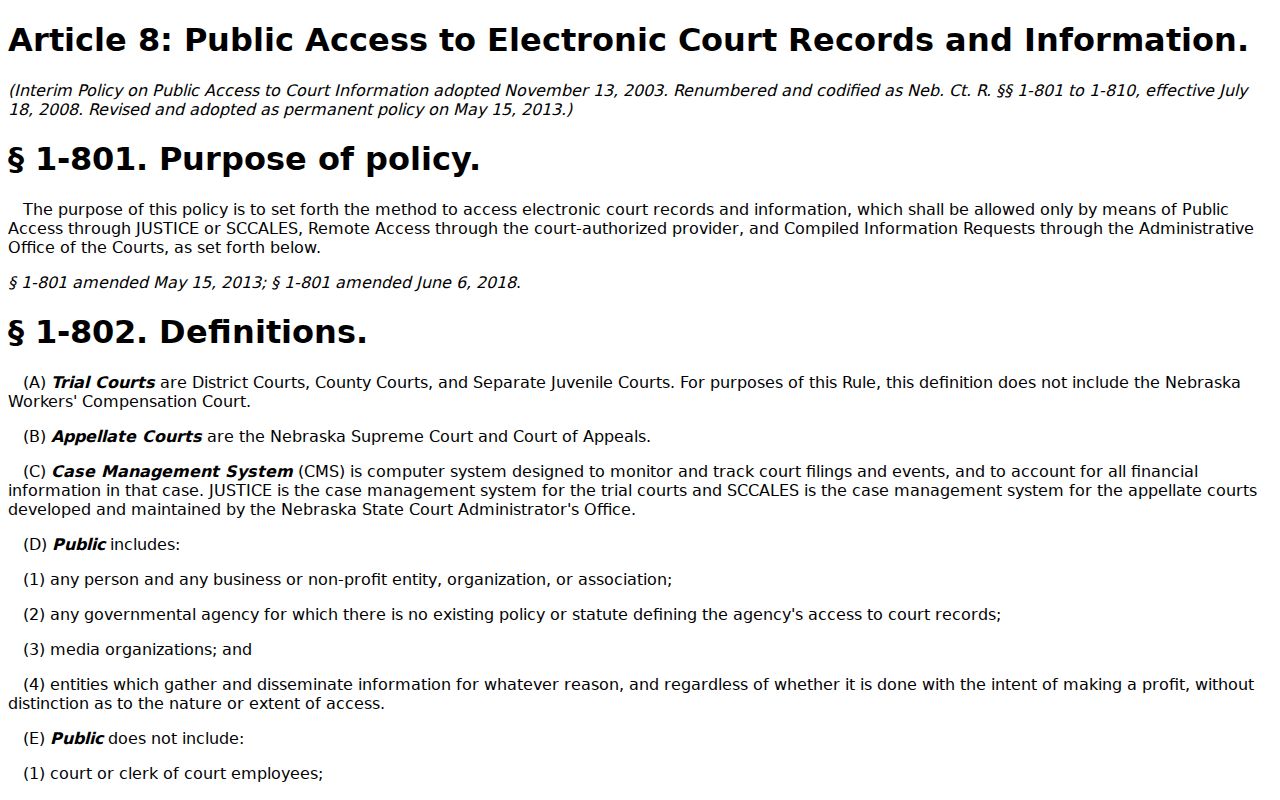
Sometimes the register lists a document that has no image online. Then you file the CC 3:29 copy form. It goes to the clerk who holds the case. A formal Nebraska Public Records Act request under section 84-712 goes elsewhere. Court policy routes it to the State Court Administrator, not to general county administration. Name the court, the case, the exact record sought, your delivery choice, and the cost estimate you want. The request then lands where it belongs.
Scotts Bluff County Criminal Copy Requests
A criminal register can point you to the complaint, an order, or a judgment. It is not itself a certified document. To get an actual copy, send CC 3:29 to the clerk holding the case. The form wants the court, case number, case name, document name, document date, a delivery choice, and prepaid costs. County Court and District Court share the form while keeping separate criminal files.
The price list on the form is straightforward. Emailed non-certified copies run no charge. Mailed non-certified copies cost $0.25 per page. Emailed certified copies are $1 per request. Mailed certified copies add $1 per seal plus $0.25 per page. No turnaround time is promised. So ask the clerk about payment, delivery, and access details before you send anything.
Sealed Dockets and Public Access
Public access stops at a line. Nebraska Article 8 makes specified electronic court information public unless a rule prohibits it, and Rule 2-215 generally lets anyone inspect filings at the clerk terminal or the State Law Library. Sealed adult criminal records, juvenile matters, restricted hearings, confidential filings, and protected identifiers may be withheld, limited, or missing from any result. A blank search hit is not always a seal, though. Court level, a spelling slip, installation date, paper records, retention schedules, or a restriction can each hide a Scotts Bluff County court docket just as easily.
Access rules. Nebraska section 29-3523 governs adult criminal-record sealing and authorized access. Rule 6-1524 limits public criminal identifiers, including full Social Security and taxpayer ID numbers. The eligible subject of a sealed record may use form DC 1:12 with the required identification and request details.
Scotts Bluff County runs Adult Drug Court and DUI Court as problem-solving programs, not as a separate public docket database. The Judicial Branch program listing carries the program details.
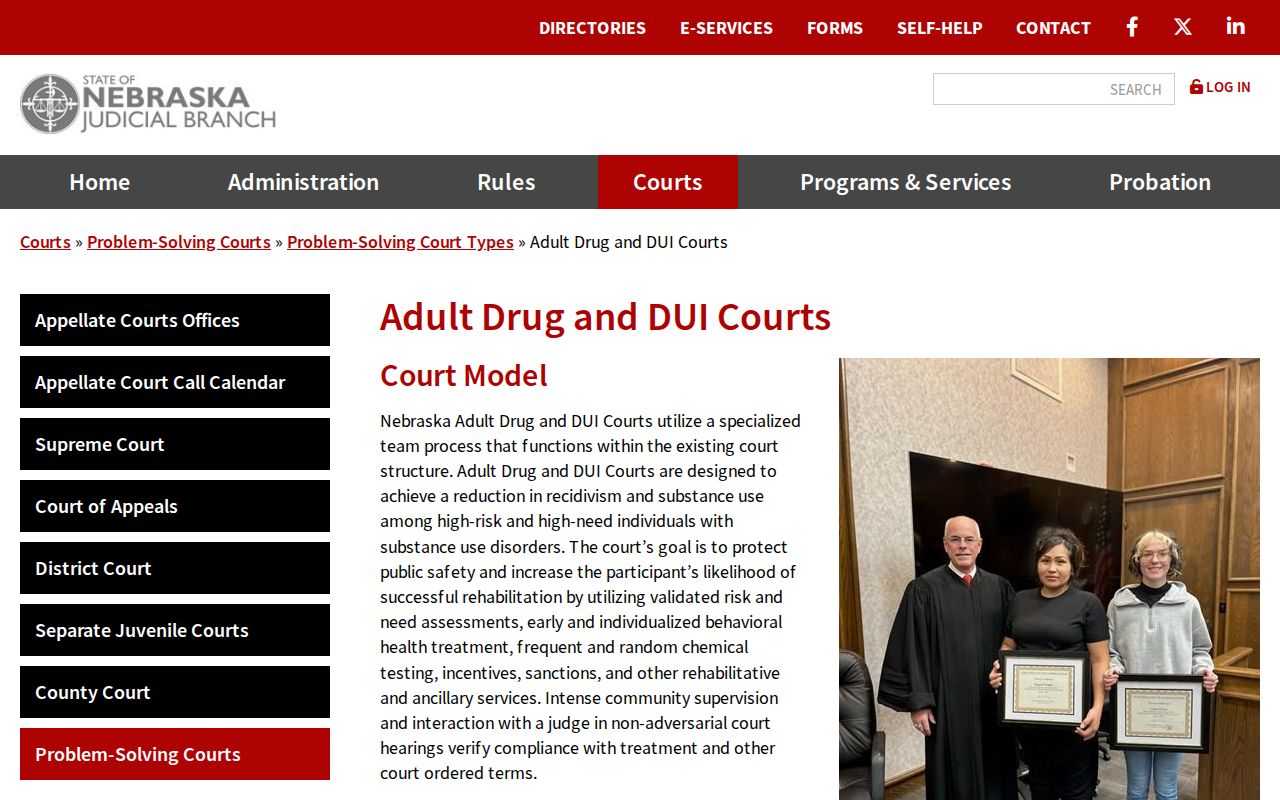
For a case tied to one of those programs, search the underlying County or District Court docket itself. Then ask the right clerk or program office what access is authorized. Never lean on a public lookup to slip past a sealing or confidentiality rule.